
The Current | April 1–15, 2026: Trustworthy Isn’t Something You Say
Every two weeks, we send The Current to B2B leaders who want communications intel they can actually use. Below is our latest issue. If you’d like it delivered directly to your inbox, you can subscribe at the bottom of this page.
This issue: trustworthy isn’t something you say. Here’s how B2B buyers actually decide who to trust — and what it takes to be the obvious choice.
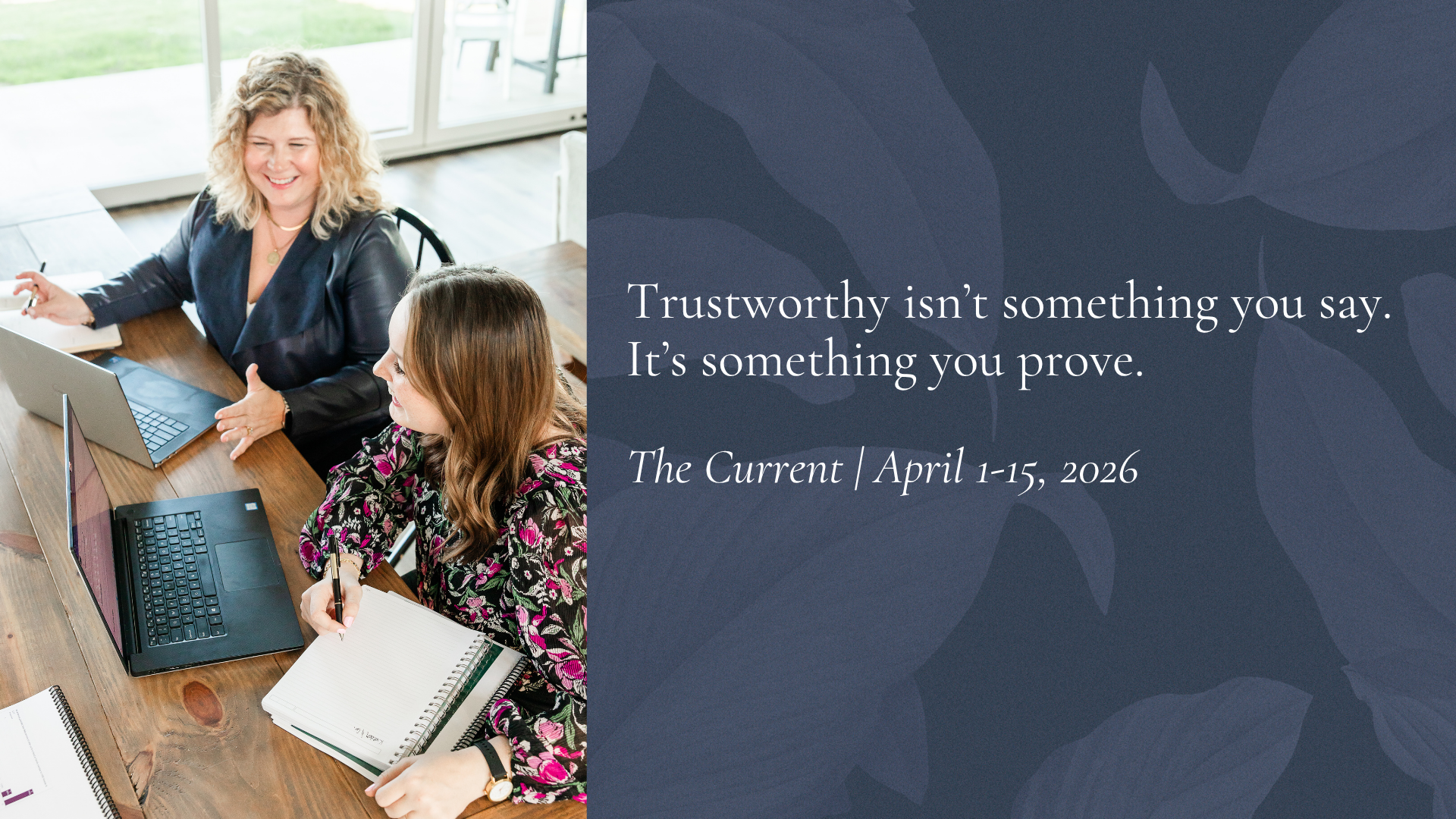
The Current | April 1–15, 2026 — Kwedar & Co.
The lead
Trustworthy isn’t something you say. It’s something you prove.
Telling a B2B prospect you’re worthy of a multi-million dollar contract is very different from demonstrating it. And the flood of AI-generated content that uses a lot of words to say very little isn’t moving the needle.
Buyers are better equipped and more discerning than ever. By the time you meet a prospect, they’ve likely already formed an opinion, you just have to validate (or dispel) the assumptions they’ve arrived with. According to a 2026 SurveyMonkey and Reddit study of 1,200 B2B decision-makers, 83% self-research before ever speaking to sales. When they do, they trust peer recommendations (73%) far more than your website (55%) or an AI chatbot (39%). Forrester puts it plainly: in 2026, trust is earned, not claimed.
According to a 2026 SurveyMonkey and Reddit study of 1,200 B2B decision-makers, 83% self-research before ever speaking to sales. When they do, they trust peer recommendations (73%) far more than your website (55%) or an AI chatbot (39%). Forrester puts it plainly: in 2026, trust is earned, not claimed.
So how do you show you’re trustworthy? Clear, specific, consistent, human messaging — backed by third-party, authority-building content that reinforces it. Bylined articles in reputable outlets. Podcast appearances. Meaningful case studies. The companies landing on a buyer’s shortlist before the first call aren’t louder. They’re clearer, and someone credible has already vouched for them.
This week, do an honest lap around your digital presence: your website, your blog, every social profile, every industry platform you appear on. Ask whether who you are in 2026 is clear, accurate, and consistent with what’s coming out of your mouth in presentations and sales calls. If there’s a gap, that’s where you start.
What we're seeing
The manufacturers and industrial companies we’re talking to right now are busier than ever. Quoting more. Attending more trade shows. Showing up more consistently than they have in years.
And yet deals are slower. Margins are getting squeezed. Conversations that should be straightforward are turning into price negotiations.
Here’s what we think is happening: activity isn’t the same as visibility, and visibility isn’t the same as credibility. A prospect who doesn’t already know you — who found you through a referral or a Google search or a show floor conversation — has no frame of reference for why you’re worth the number on your quote. So they do what any reasonable buyer does when they can’t differentiate: they push on price.
The problem usually isn’t the product. It’s that the story surrounding the product hasn’t kept pace with the company’s actual capabilities. What you do in 2026 is almost certainly more sophisticated, more proven, and more differentiated than what your website and your sales materials say you do.
That gap is expensive.
The cautionary tale
We worked with a company not long ago that was, by every measure, excellent at what they did. Strong team. Real results. Happy clients. But when we asked them who they served best, the answer was essentially: anyone who needs us.
That’s a common answer. It’s also an expensive one.
Because they couldn’t clearly define their lane, their referral partners didn’t know who to send them. The clients they did land struggled to articulate the value — which made renewals harder to justify. And then, almost without warning, their pipeline fell off a cliff.
When we finally helped them get specific — about their industry, their ideal client, their actual differentiator — there was an immediate shift. Referral partners started connecting them to the right conversations. Prospects felt seen rather than sold to. The message landed because it was finally honest.
Clarity isn’t a marketing exercise. It’s a revenue strategy.
One thing worth your time
Ask three people outside your company — a vendor, a former colleague, a referral partner — to describe what you do and who you serve best. Don’t coach them. Just listen.
If the answers are consistent, you’re in good shape. If they’re not, you have your answer.

About The Author
Lauren Kwedar Cockerell is founder and president of Kwedar & Co, a Fort Worth-based PR, messaging, and strategic communications firm serving purpose-driven B2B companies. She is also the firm’s lead PR and marketing strategist, host of our podcast The Impatient Entrepreneur, as well as a frequent podcast guest.
Over the past 20+ years, she has worked with 100s of leaders and organizations to create PR and marketing strategies and tactics that support visions and reach goals.
To connect with Lauren, please send an email above, or book a consultation.